Mastering Cube Roots: The Ultimate How-To Guide
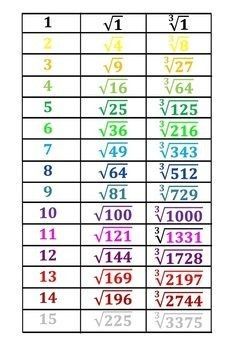
Finding the cube root of a number involves determining a value that, when multiplied by itself three times, equals the original number. This mathematical operation serves as the inverse of cubing a number and appears frequently in algebra, geometry, and various scientific calculations. While perfect cubes like 8 or 27 yield whole-number roots, most values require a more nuanced approach to solve accurately.
Understanding the Basics of Cube Roots
The cube root of a number \( x \) is represented as \( \sqrt[3]{x} \) or \( x^{1/3} \). For example, the cube root of 64 is 4 because \( 4 \times 4 \times 4 = 64 \). It is important to distinguish between square and cube roots, as the latter involves multiplying a number by itself three times rather than twice. This fundamental concept underpins more advanced problem-solving techniques in higher mathematics.
Prime Factorization Method
One of the most reliable ways to find the cube root of an integer is through prime factorization. This method involves breaking down the number into its prime factors and grouping them in sets of three. Each group of three identical factors can be taken outside the cube root, simplifying the expression. This approach is particularly effective for numbers that are perfect cubes or have large exponents.


Step-by-Step Calculation
- Decompose the number into its prime factors.
- Group the factors into triples.
- Multiply the factors that form complete groups.
- The product represents the cube root if all factors are fully grouped; otherwise, the remaining factors stay under the radical.
For instance, to find the cube root of 216, you factor it into \( 2 \times 2 \times 2 \times 3 \times 3 \times 3 \). Grouping them as \( (2 \times 2 \times 2) \) and \( (3 \times 3 \times 3) \) allows you to extract 2 and 3, resulting in a cube root of 6.
Estimation and Approximation
When dealing with non-perfect cubes, estimation becomes a practical skill. By identifying the nearest perfect cubes above and below the target number, you can narrow down the range of the cube root. This manual approach provides a quick mental calculation that is useful in everyday scenarios where a calculator is not available.


Interpolation for Greater Accuracy
For a more precise approximation, linear interpolation can be applied between the two nearest perfect cubes. This mathematical technique refines the estimated value by considering the proportional distance of the target number between the two bounds. While not yielding an exact integer, it offers a decimal approximation suitable for engineering and physics applications.
Using Technology and Calculators
Modern technology has simplified the process of finding cube roots. Scientific calculators and software like Excel or Google Sheets include built-in functions for computing \( n \sqrt{x} \) or \( x^{(1/3)} \). These tools are invaluable for handling complex numbers or decimals, ensuring speed and accuracy in professional environments where computational demands are high.
Handling Negative and Fractional Roots
The method extends to negative numbers, as a negative multiplied by itself three times results in a negative product. The cube root of -8, for example, is -2. Similarly, fractional numbers can be addressed by applying the same prime factorization logic to both the numerator and denominator. This versatility makes the concept applicable across a wide spectrum of numerical values.


Related Articles

Mastering My Crystals: The Ultimate How-To Guide for Beginners
Welcome to a practical guide on how to use my crystals. For centuries, people have turned to these beautiful mineral formations to support clarity, balance...

The Ultimate Guide to Growing & Cooking Mustard Green Roots
Mustard green root, often overlooked in favor of its leafy counterpart, is a culinary treasure waiting to be discovered. This underutilized part of the plant...

How Deep Do Garlic Roots Grow? The Ultimate Guide to Root Depth
Garlic, the pungent bulb that flavors cuisines worldwide, is often misunderstood regarding its foundational structure. While the cloves we harvest and cook...

Mastering Floor Joist Direction: The Ultimate Guide for Strength and Compliance
Understanding floor joist direction is one of the most critical, yet overlooked, aspects of structural framing. The orientation of these horizontal members...

Decadent Chocolate Chess Pie: The Ultimate How-To Guide
Chocolate chess pie is a Southern classic that marries the simplicity of pantry staples with the deep, satisfying flavor of cocoa. This no-bake dessert...

The Ultimate Guide to Floral Art: Mastering the Language of Blooms
Floral art is the ancient practice of arranging living plant materials into intentional, expressive compositions. Far more than a simple collection of flowers...