Effortless Guide: Find the Surface Area of a Cone Instantly
Understanding how to find the surface area of a cone is essential for anyone studying geometry, whether they are a student tackling homework or a professional working in fields like architecture or engineering. The surface area represents the total amount of space that the exterior of the three-dimensional shape occupies, and for a cone, this includes both the circular base and the sloping lateral surface that tapers to a point.
The Components of a Cone
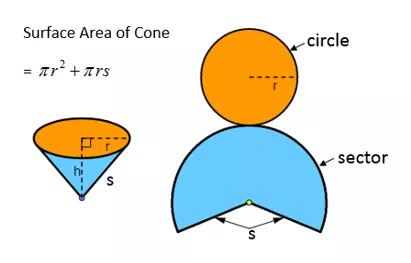
To successfully calculate the surface area, you must first identify the specific measurements associated with the cone. Unlike a cylinder, which has a consistent radius along its height, a cone features a distinct circular base and a vertex that is not directly above the center of that base in an oblique cone. For the standard right circular cone, the primary dimensions are the radius of the base and the perpendicular height. However, when calculating the curved surface area, the most critical measurement is the slant height, which is the diagonal distance from the base edge to the vertex.
Identifying the Radius and Height
The radius (r) is the distance from the center of the circular base to any point along its edge. This measurement defines the size of the base circle. The perpendicular height (h) is the straight-line distance from the center of the base up to the apex (the tip of the cone). While the height is crucial for determining volume, it does not directly provide the length needed to calculate the slanted surface. This is where the Pythagorean theorem becomes necessary to bridge the gap between the height and the slant dimension.


Understanding Slant Height
The slant height (l) is the hypotenuse of a right-angled triangle formed by the radius, the height, and the slant line itself. Visualize a cross-section of the cone cut vertically through the apex; the resulting triangle has a base of 2r and a height of h. The slant height is the diagonal side of this triangle. If you know the radius and the vertical height, you can find the slant height using the formula: \( l = \sqrt{r^2 + h^2} \). This step is non-negotiable if you want to find the true surface area accurately.
The Formula for Surface Area
The total surface area of a cone is the sum of the area of the base and the lateral (curved) surface area. The base is a simple circle, so its area is calculated using the standard circle formula, \( \pi r^2 \). The lateral surface area requires the slant height and is calculated using the formula \( \pi r l \). Therefore, when you combine these two distinct parts, the comprehensive formula to find the surface area of a cone is \( \pi r (r + l) \). This elegant equation ensures that both the bottom circle and the wrapping sides are accounted for.


| Measurement | Symbol | Description |
|---|---|---|
| Radius | r | Distance from center of base to edge |
| Height | h | Perpendicular distance from base to apex |
| Slant Height | l | Diagonal distance from base edge to apex |
Step-by-Step Calculation Process
Applying the formula requires a systematic approach to avoid errors. First, confirm the dimensions of the radius and the height. If you are only provided with the height, use the Pythagorean theorem to calculate the slant height before plugging it into the surface area formula. Next, square the radius value and multiply it by pi to find the base area. Then, multiply the radius by the slant height and pi to find the lateral area. Finally, add these two results together, or use the simplified formula \( \pi r (r + l) \) to perform the calculation in a single step. Precision in measurement is the difference between a theoretical answer and a practical one.
Practical Applications and Real-World Relevance
The ability to determine the surface area of a cone extends far beyond the classroom. In the world of packaging design, manufacturers must calculate the exact amount of material needed to create conical cups or ice cream cones to minimize waste and control costs. Architects and designers use these calculations when creating structures with conical roofs or spires, ensuring they order the correct quantity of roofing or cladding materials. Even in the culinary arts, understanding the surface area can help chefs determine the rate of evaporation or the surface exposure to ingredients during specific cooking processes.




Related Articles

Surface Area Formula for a Triangular Prism: Easy Calculation Guide
Understanding the surface area formula for a triangular prism is essential for anyone studying geometry, whether in a high school classroom or applying these...

Effortless Silicone Residue Removal: The Ultimate Guide to Clean Surface
Sticky silicone residue is one of those household frustrations that can turn a simple project into a test of patience. Whether it is the leftover film from a...
Master the Surface Area of a Triangular Prism: Step-by-Step Formula Guide
Understanding the surface area triangular prism formula is essential for anyone tackling geometry problems, whether they are students mastering foundational...

Effortless Lime Deposit Removal: The Ultimate Guide to a Scale-Free Surface
Lime deposit removal is a critical maintenance task for any household or business that relies on consistent water flow and appliance longevity. These stubborn...

Master the Triangular Prism Surface Area Formula: Step-by-Step Guide
Understanding the triangular prism area formula is essential for anyone working in geometry, engineering, or architecture. This specific calculation allows you...

8x12 Rugs: Your Guide to Perfectly Sized Living Room & Bedroom Area Rugs
An 8 x 12 rug sits at the sweet spot of residential flooring, offering the expansive presence needed to ground a room without overwhelming a moderate space...